


John Miličić
History of Place
27. 10. - 20. 11. 2026. Galerija Manuš, Zagreb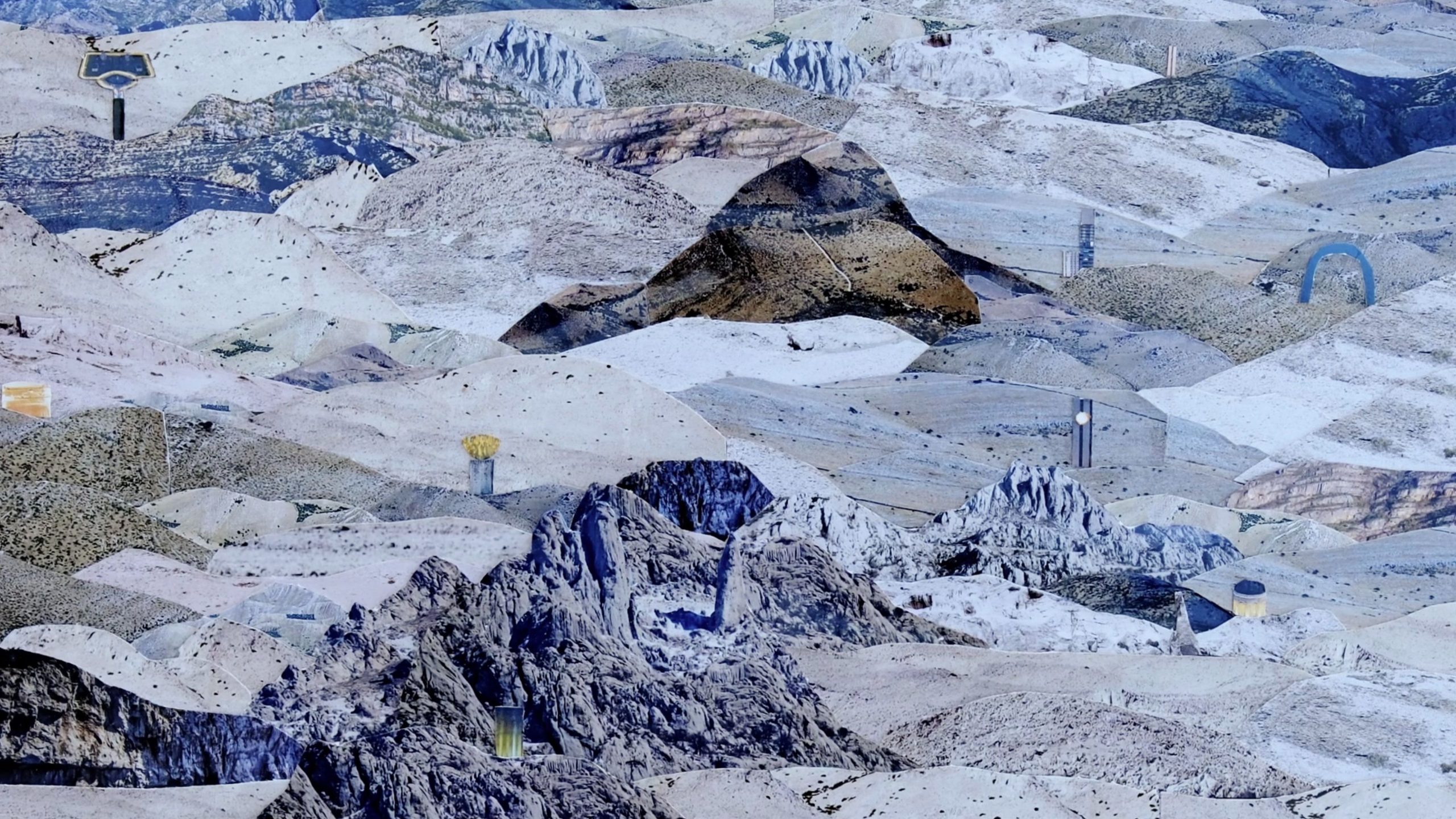
John Miličić’s earlier landscapes are not clear vistas, but rather reconstructions of space experienced in motion, shaped by shifting viewpoints and the selective lens of memory. The gap between seeing and its depiction is integral to the composition, as are the circumstances in which it occurs. In his new show, Miličić extends this inquiry to images that predate his own gaze, exploring the ways spatial experience can be reconfigured, stored, and re-displayed.
Italo Calvino’s Invisible Cities offer Miličić a framework for a visual structure that makes description convincing. Just as Calvino’s Marco Polo and Kublai Khan conjure fictional cities from the inhabitants’ memories and desires, Miličić uses painting to give credibility to a place that does not exist. For him, a sense of belonging is more than a list of landmarks; it is the ability to create a credible depiction that avoids conventional tropes. The experience of a place diverges from representations that reduce its unique identity to entrenched signs.
The collages in the History of Place series are made by cutting postcards of Hvar, Split, Zagreb, Dubrovnik, as well as national parks, into snippets of architecture, terrain, vegetation, and color, that the artist then reassembles into a non-existent topography. The houses and hills are photographic evidence of real places, yet their spatial relations are purely imaginary. Individual photographs confirm the origin of each fragment, while the composition establishes the credibility of the whole. Far from neutral photographic sources, these postcards are mass-reproduced commercial images, often sentimental and kitschy, that reduce an actual place to a catalogue of attractive scenes. Panoramas, historic centers, and coastlines commodify the destination, and the framing, editing, and printing have already dictated the gaze before the artist intervenes. Rather than bypassing this to seek a more “authentic” landscape, Miličić adopts fragments of this manufactured gaze as material for his painting.
The concept of local color bridges painterly theory with geography, as a characteristic motif colors the expected image of a place. Instead of mixing paints on a palette to depict the sea and hills, Miličić utilizes their printed colors mediated by photography and marketing. Their interchangeability across geographies exposes the paradox of the tourist image: a destination’s unique identity is validated through a standardized visual language. In a conceptual twist, postcards meant to identify real places become the building blocks for an imaginary city, mass reproduction part of unique handiwork. Miličić uses imagery that traps a place in a permanent, alluring present to construct its history – from foundation and growth to overbuilding, decay, and the return of nature. Dystopia here does not reject the tourist aesthetic; instead, desirable motifs are layered to the point of spatial saturation, turning an idyllic scene into its opposite.
Such work with real-world imagery is central to re-examining the image, representation, and its traditional values. The Cubist collages by Picasso and Braque from 1912 onward used ready-made materials to blur the boundary between picture and object, radically challenging painterly conventions. A collage is not less valuable than traditional painting; it simply resolves artistic questions by means other than applying paint to canvas. Rather than intact postcards, Miličić juxtaposes their fragments that function both as recognizable motifs and painterly marks. The rhythm of roofs, tonal relationships, dense vegetation, and spatial planes form a new cityscape. The cut assumes the function of a brushstroke, yet the transitions remain exposed, while discrepancies in scale and perspective simultaneously establish and disrupt the illusion that the viewer must complete. From afar, the fragments blend into a cityscape; up close, they once again dissolve into pieces of photographs, causing the work to oscillate between a painterly and a photographic mode of seeing. By evoking the tradition of the capriccio and the ideal city, these works establish a pictorial order that makes the non-existent convincing, while echoes of Piranesi’s Carceri evoke a sense of disorientation born from impossible architectural relationships.
The Turn Machine (Stroj za zavoj) shifts this exploration of the image from composition to duration. A device resembling a television set mechanically scrolls a painted depiction of a path, accompanied by a whir of its mechanism, contrasting the expected electronic image with the physical movement of a painterly surface. The sound is more than mere accompaniment; it serves as sensory proof of the process that makes the scene visible. The artist’s earlier painting consolidated memories of movement into a static image; here the viewers remain stationary while the painted path passes before them. Miličić describes the machine as the stored memory of a locality that, reactivated, does not replicate the original experience but establishes a new, mechanically determined viewing time. Just as the visible cut in a collage exposes the construction of space, the mechanical sound makes the conditions of its display tangible. This almost conceptual process does not replace painting, but rather uncovers what a painterly image often conceals.
Ultimately, these works share an exploration of how selected, remembered, or adopted fragments coalesce into a convincing image of space. The very processes that allow an imaginary city to seem real expose the degree to which our perceptions of actual places are shaped by selection, idealization, and repetition, while the machine shows how the experience of passing through can be transformed into a stored and reactivated representation.
By exposing compositional choices, the materiality of the cut, and the mechanism of movement – instead of subordinating them to a seamless illusion – Miličić challenges both the limits of the medium and the authority of the image to dictate how we see, remember, and recognize space as our own.
Jelena Šimundić Bendić
Juraj John Miličić (b. 1992, Split, Croatia) graduated in painting from the Academy of Fine Arts in Zagreb in 2018.
Selected group exhibitions: 6th Painting Biennale, HDLU, Zagreb, 2021, Hvar URB Art, public spaces of Hvar, 2022, 7th Painting Biennale, HDLU, Zagreb, 2023, 37th Youth Salon, HDLU, Zagreb, 2024, Rebot_1.0, FOMO Art Space, Zurich, 2025, Kvart, Split, 2025, Garaža Kamba (with Svan Radulović) 2025.
Selected solo exhibitions: Landscape, Matica hrvatska, 2017, Potemkin’s Guests, Hvar City Gallery, 2021, Zagreb–Split–Hvar, SC Gallery, Zagreb, 2024, Manuš, Split, 2025.
Awards: Third Prize, 37th Youth Salon, 2024, HDLU Annual Award for Best Young Artist, 2024