


Carlos Amorales
The War of the Worlds
27. 5. - 31. 7. 2026. Galerija Manuš, Zagreb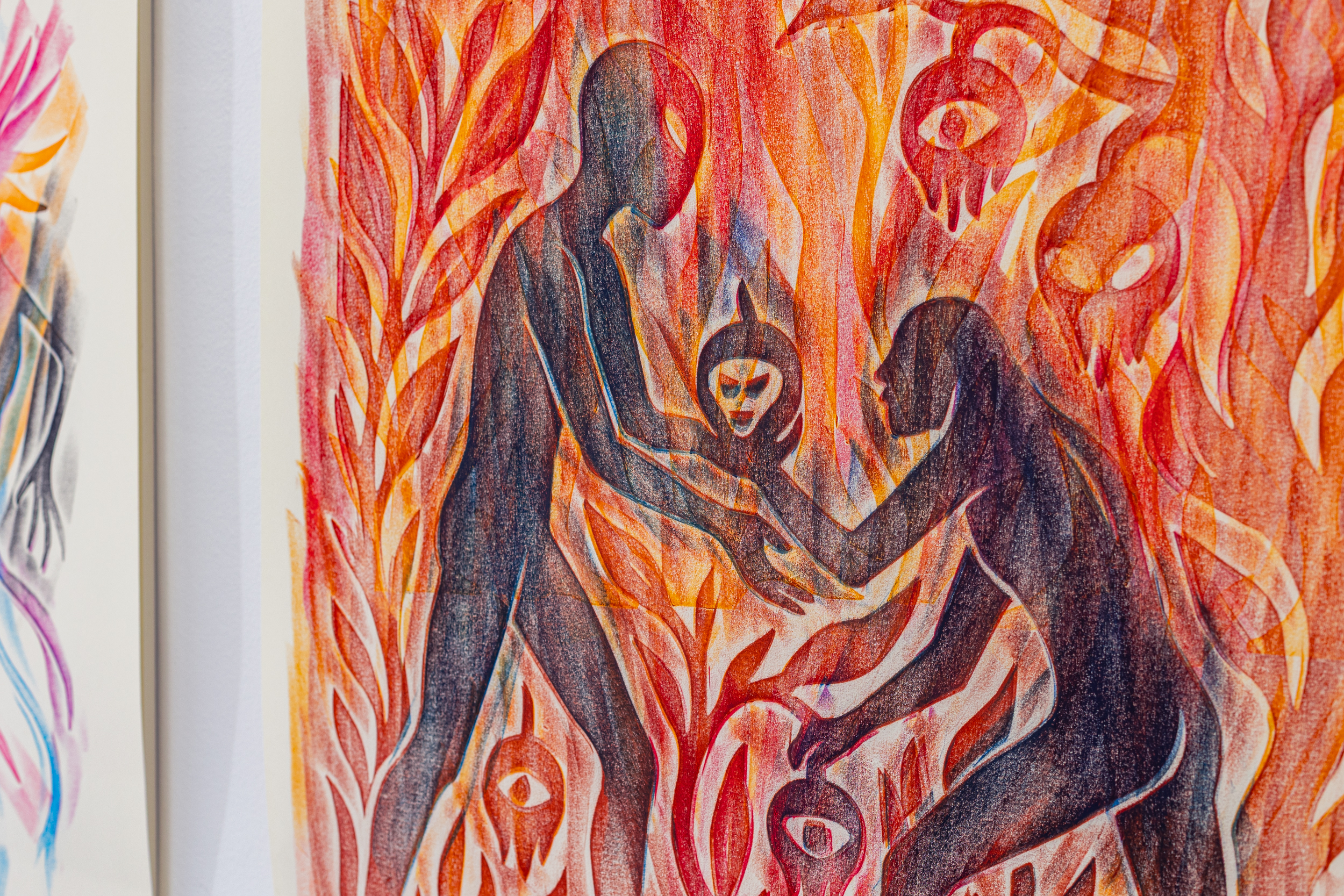
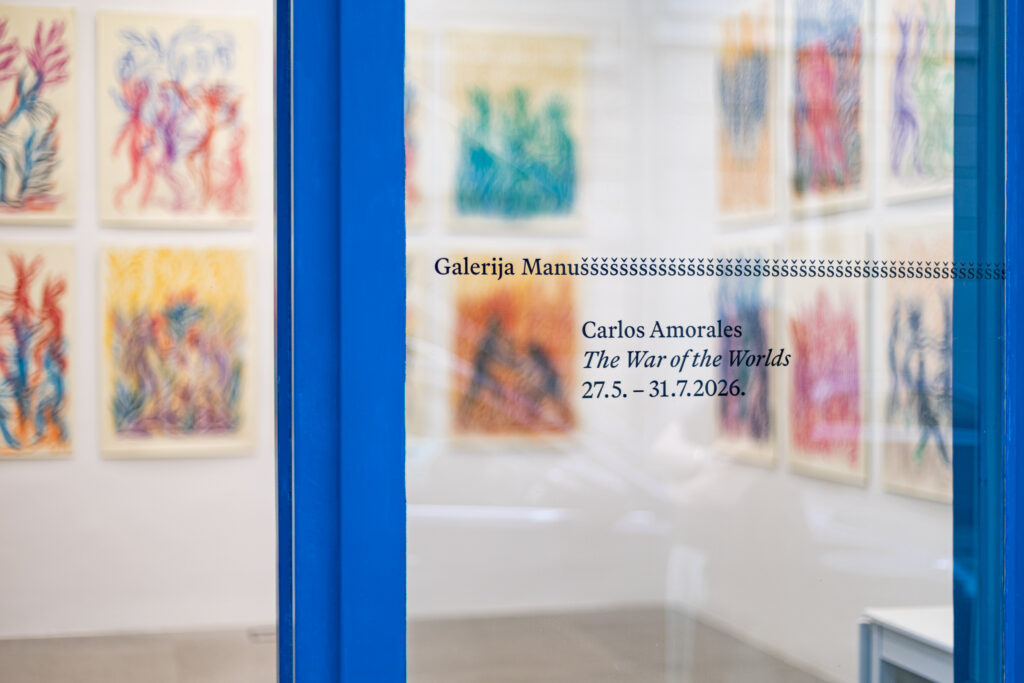
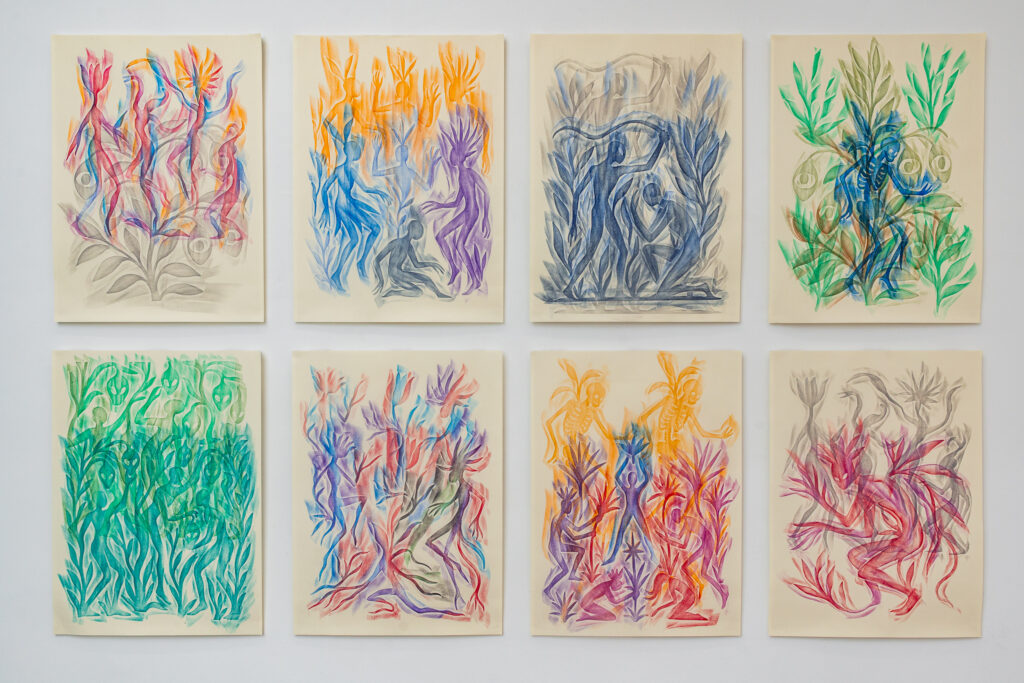
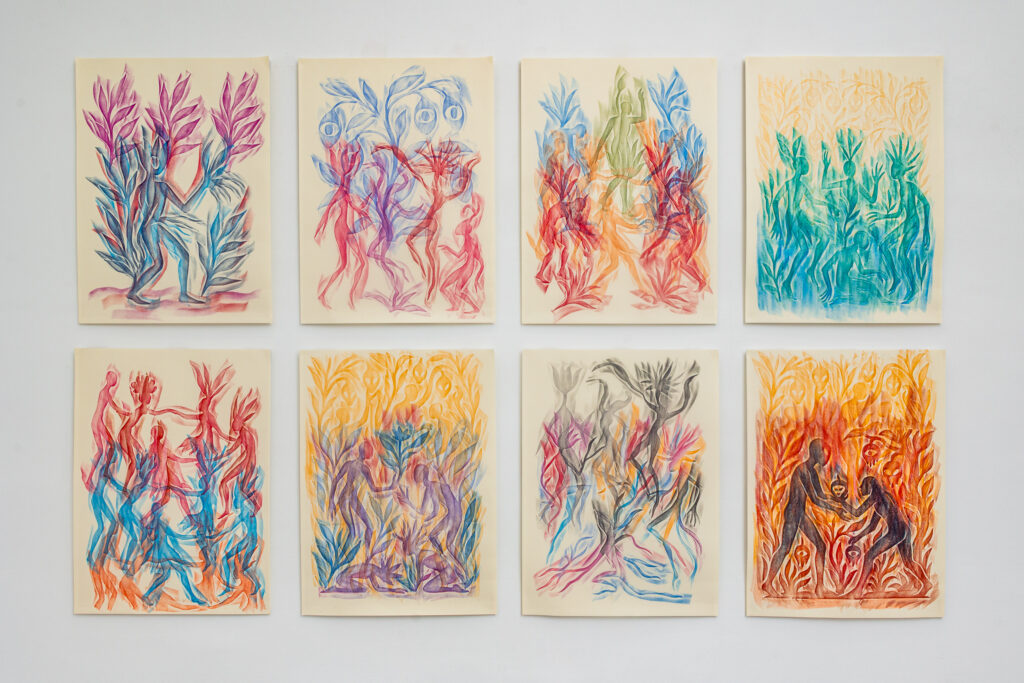
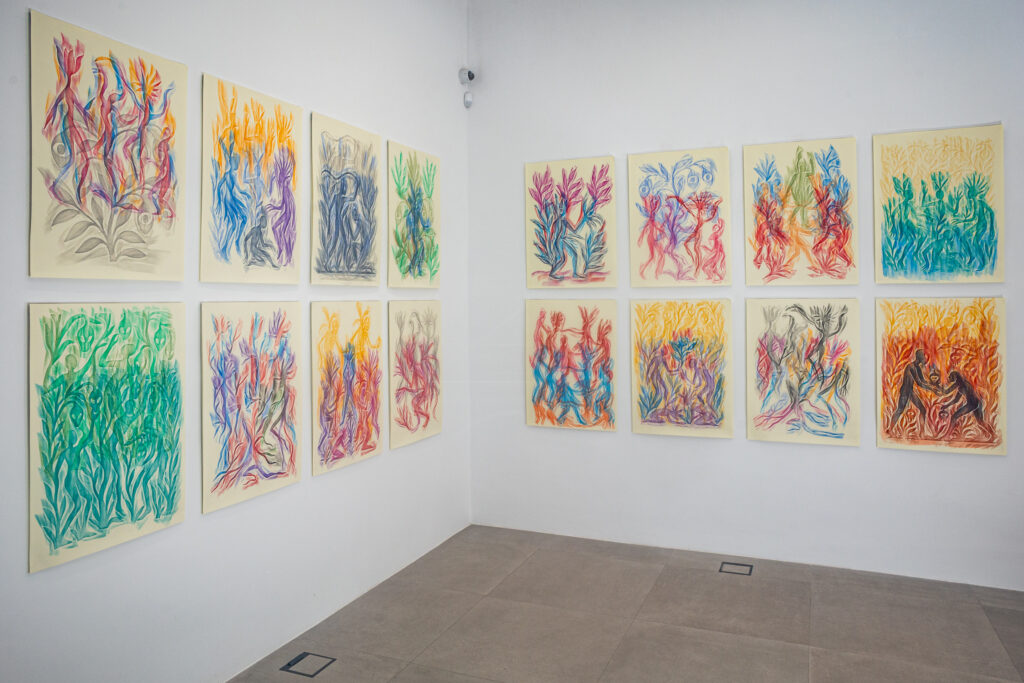
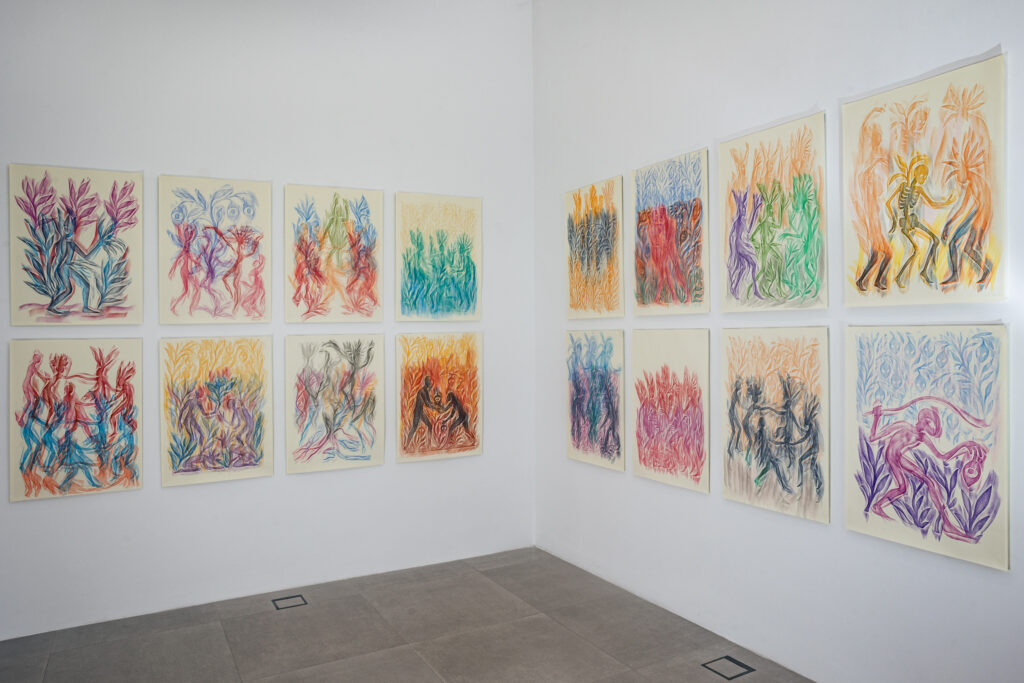
The War of the Worlds by Carlos Amorales
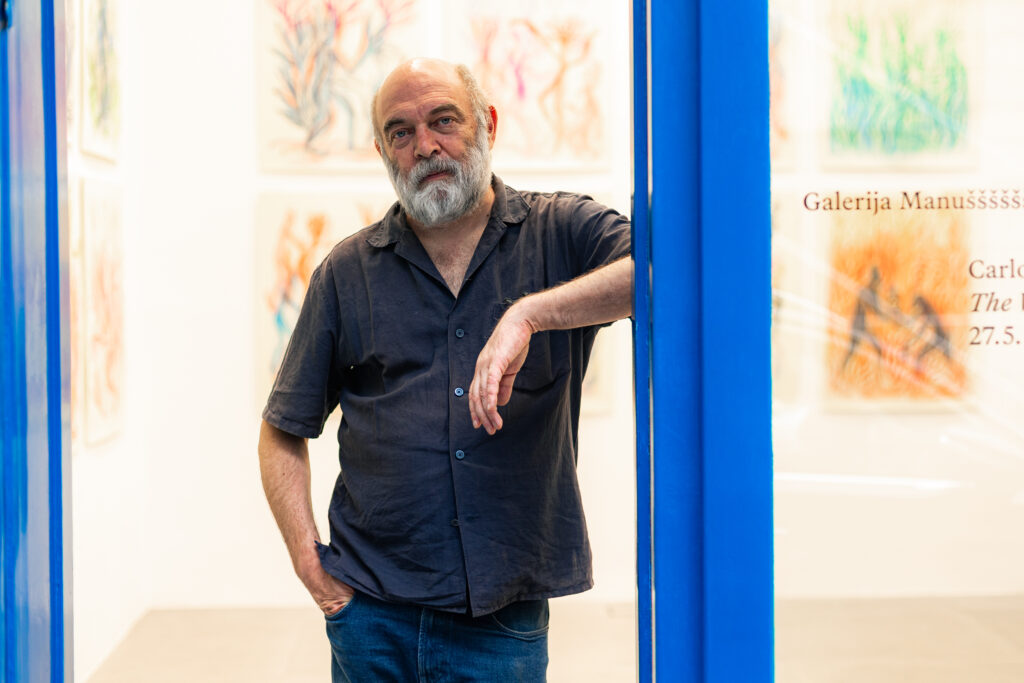
After last year’s exhibition in Split, Carlos Amorales, one of the most captivating and internationally recognized contemporary artists, is now presenting his recent work to Zagreb audiences. Amorales has developed his own visual “language” and system of signs through an array of platforms, including drawing, installation, animation, and video. Exploring themes of identity, otherness, language as a structure of power, and the relationship between mass culture, politics, and violence, the artist has gained recognition for his immersive installations and series of drawings that function as open, narratively fragmented visual systems.
Two experiences were central to the formation of his artistic ideas. One is the 1985 Mexico City earthquake that was a watershed moment for the artist, both ethically and aesthetically. His response to the destruction was ambivalent: he felt deep compassion for the victims, yet it was his fascination with the ruins that profoundly shaped his visual idiom. This ambivalence led him to understand destruction not only in negative terms, but also as a chance for regeneration and a new social order. The other is the experience of migration – otherness – the position of a stranger in a strange land, rooted in both his personal and family history. Having spent his formative years in Europe, he has focused his artistic inquiry on hybrid interspaces and fractures of identity. The motif of migration refers not only to geographic displacement but also to his artistic method; he describes himself as an artist who migrates from medium to medium and from theme to theme, rebelling in a way against stability demanded by the art market. This enables him to shift forms and perspectives while preserving the sense of displacement and transformation characteristic of the migrant experience.
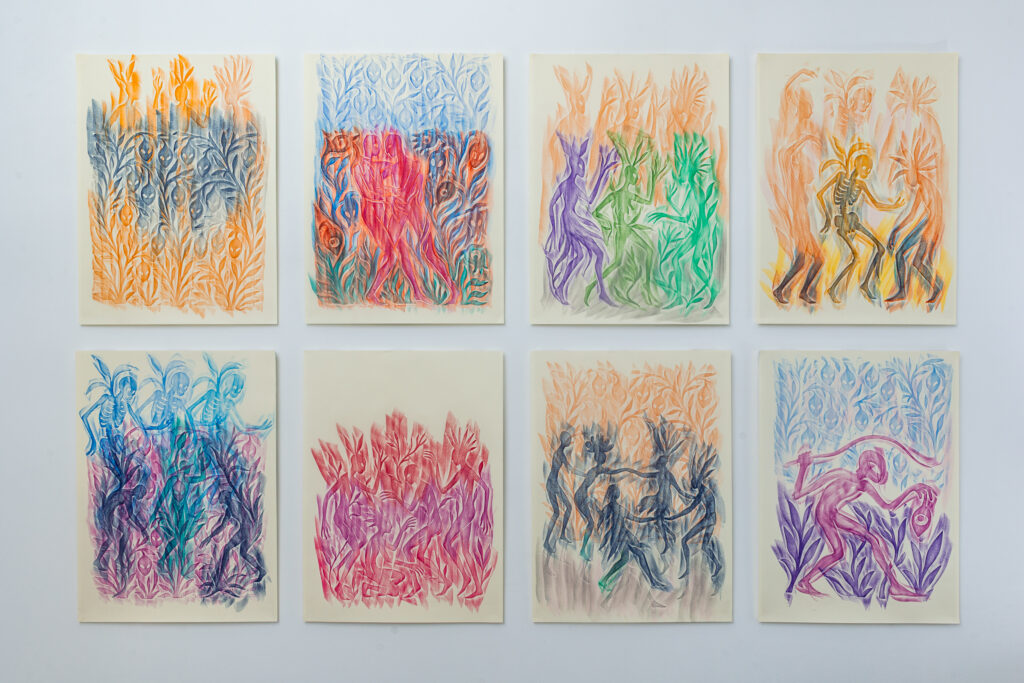
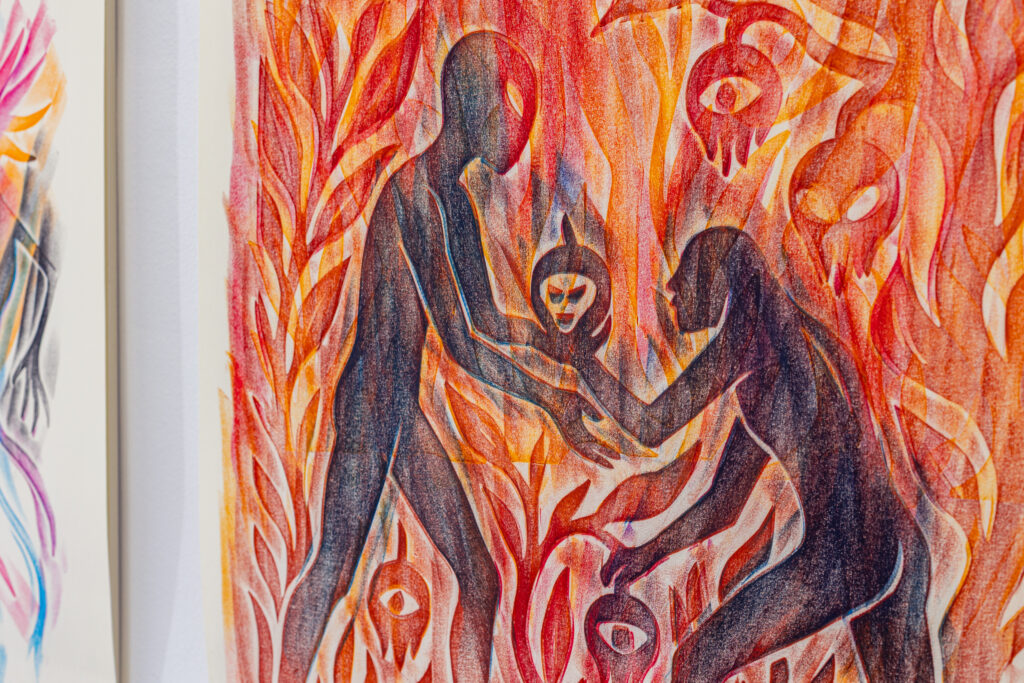
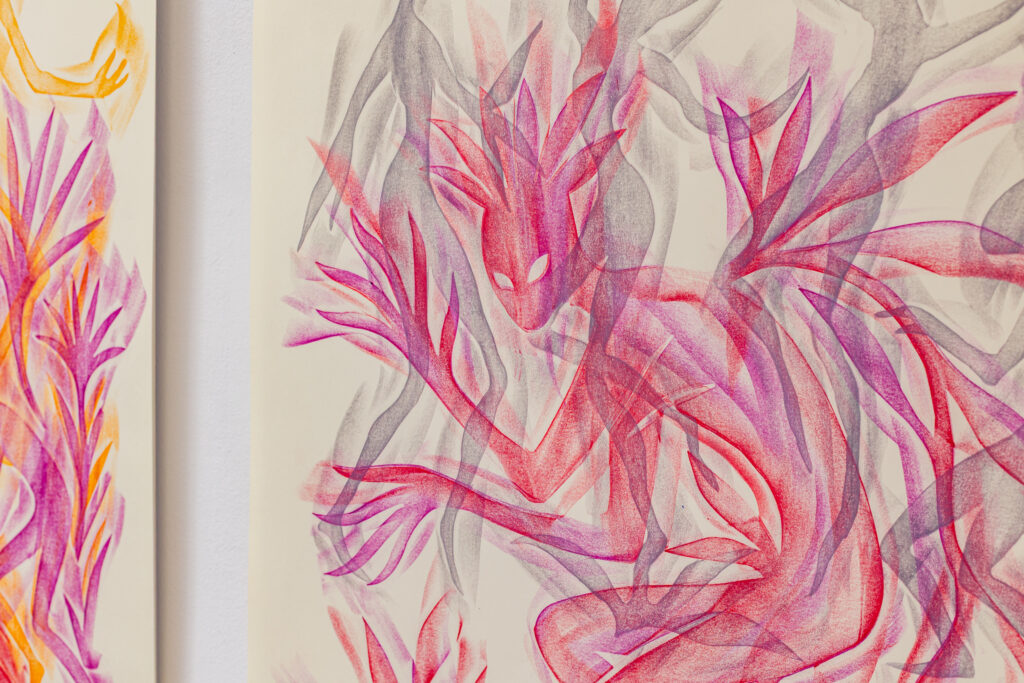
Amorales’s new series of works on paper, presented at Galerija Manuš in Zagreb, inspired by The War of the Worlds by H. G. Wells — whose title the artist appropriates — introduces viewers to a world of demonic beings, organic forms, and ritualistic imagery. The drawings teem with silhouettes of non-human and vegetal forms intertwined in scenes reminiscent of tribal rituals. Their dynamic quality is underscored by contrasting colors, each imbued with a distinct emotional charge and sense of movement. These hybrid forms dissolve the boundaries between the human, non-human, and vegetal worlds. Such visual ambiguity induces in viewers a sense of discomfort and unease, but also opens space for reflection on the ways in which we construct identity, belonging, and the notion of the Other. The drawings are not literal illustrations; rather, Wells’s novel serves as a conceptual and metaphorical framework. The novel, about the invasion of Earth by technologically superior Martians, is often interpreted as an inversion of colonial logic – a situation in which an imperial power becomes the victim of imperial aggression. Amorales adopts the structure of an “encounter with radical otherness” to reflect on contemporary forms of asymmetry, power, and violence. In his interpretation, the figure of the “alien” is a metaphor for otherness and potential colonization, with the fictional model serving as a tool for addressing current political and social tensions rather than as a literal comparison.
In this series, Amorales also explores the ways in which images function as systems for translating reality. Instead of a clear narrative, he employs hybrid bodies, organic forms, and ritual scenes to create a fragmented visual idiom, often obscure and ambiguous. This approach is characteristic of his artistic practice, in which he develops his own systems of signs and visual languages across a broad creative spectrum. In a time marked by wars, migration, and social divisions, Amorales’s drawings function as visual allegories of a world in a state of constant transformation. His morphed figures and scenes of possible catastrophe do not allow for unambiguous interpretations; rather, they invite reflection on the relationship between violence, fear, and the possibility of a new beginning. It is precisely within this instability and uncertainty that the potential for alternative forms of community and imagining the future emerges.( text Martina Munivrana)
Carlos Amorales lives and works in Mexico City. He studied in Amsterdam at the Gerrit Rietveld Academie (1996–97) and Rijksakademie van beeldende kunsten (1992–95). He has participated in artistic residencies at the Atelier Calder in Saché (2012) and MAC/VAL, Vitry-sur-Seine in France (2011), and as part of the Smithsonian Artist Research Fellowship program in Washington, D.C. (2010).
Among its most important exhibitions are: Black Cloud, Phoenix Art Museum, Phoenix, FL, US (2025); Black Cloud. Kunst Museum Brandts, Odense, Denmark(2023); Words of Mouth and Hands. Kurimanzutto. New York, United States (2023); Black Cloud. National Museum of Contemporary Art. Bucharest, Rumania (2023).The Snake of the Days. Museo Kaluz, Mexico City, Mexico (2022); The Factory. Stedelijk Museum. Amsterdam, Netherlands (2019); Ghost Demonstration. BAMPFA. Art Wall Project, Berkeley, United States(2019); Axioms for Action, MUAC – Museo Universitario de Arte Contemporáneo, Ciudad de México, México. (2018) (2019); Herramientas de trabajo, MAMM- Museo de Arte Moderno de Medellín, Colombia (2017); Working Class Today… Mañana Nuevos Ricos!, Fridericianum, Kassel, Alemania (2009); Carlos Amorales, Museo de Arte Latinoamericano de Buenos Aires, Argentina (2006); ¿Por qué temer al futuro?, Casa de América, Madrid and Artium, Vitoria, España (2005).
In addition to representing Mexico at the 57th Venice Biennale with the project Life in the Folds (2017), His work has been included in other biennials such as the 10th Shanghai Biennale, China (2013); 2nd and 8th Berlin Biennale (2001 and 2014); Sharjah Biennial 11, United Arab Emirates (2013); 10th and 12th Havana Biennial, Cuba (2009 and 2015); the 5th SeMA Biennale Mediacity Seoul in Seoul, Korea (2008); and he represented The Netherlands at the 50th Venice Biennale participating in the exhibition “We Are The World”.